
Top 5 Tools for Building a Resilient Supply Chain
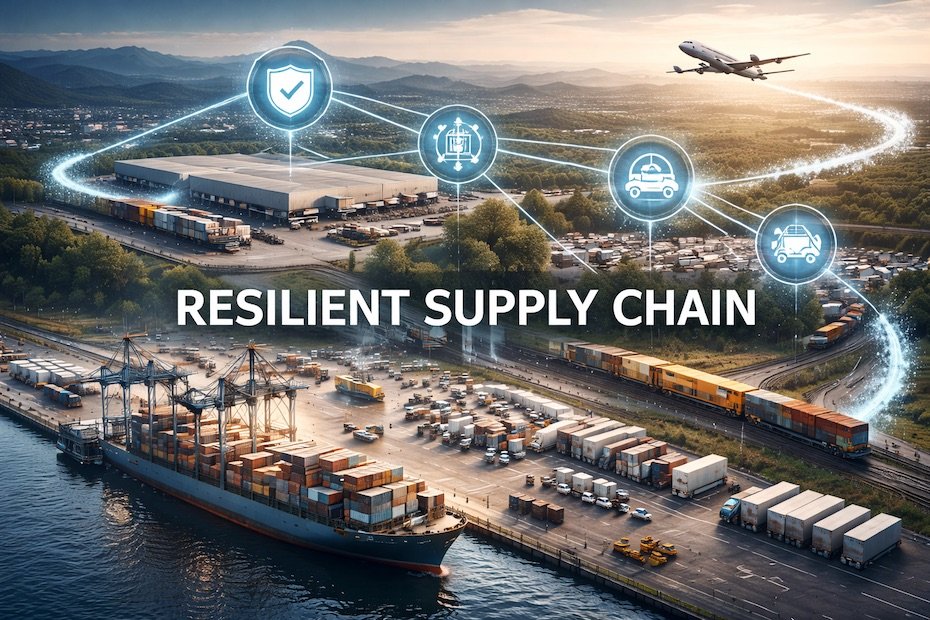
Table of Contents
- Tool 1: Real-Time Supply Chain Visibility Platforms
- Tool 2: Risk Intelligence and Disruption Monitoring Systems
- Tool 3: Predictive Forecasting and Scenario Planning Software
- Tool 4: Supply Chain Network Mapping and Dependency Analysis
- Tool 5: Collaboration and Execution Alignment Platforms
- How These Tools Work Together to Strengthen Resilience
- Why Tool Selection Matters More Than Tool Quantity
- Tools That Build Supply Chain Resilience
- Build Resilience Before the Next Disruption Hits
A resilient supply chain depends on your ability to see disruptions early, respond with speed, and adjust operations without losing control of cost or service levels. The most effective way to achieve that level of resilience is by deploying the right technology stack that supports visibility, prediction, coordination, and execution at scale.
This article breaks down the five essential tools that consistently strengthen supply chain resilience in complex, multi-node environments. This will explain how the tool contributes to operational stability, where it delivers measurable value, and how experienced supply chain leaders apply it in real-world conditions.
Tool 1: Real-Time Supply Chain Visibility Platforms
Real-time visibility platforms form the foundation of a resilient supply chain by giving you a unified view of inventory, shipments, production status, and transportation performance across the network. These systems consolidate data from carriers, warehouses, suppliers, and internal systems into a single operational interface that updates continuously.
With visibility in place, you no longer rely on delayed reports or fragmented updates. You detect late shipments, port congestion, inventory imbalances, or production delays as they occur. That immediacy allows you to reroute freight, rebalance inventory, or adjust fulfillment priorities before service levels deteriorate.
Over time, visibility platforms also generate historical performance data that reveals recurring weak points in your network. You gain clarity on which lanes, suppliers, or facilities consistently introduce risk, allowing you to redesign flows, renegotiate contracts, or diversify sourcing with confidence.
Tool 2: Risk Intelligence and Disruption Monitoring Systems
Risk intelligence tools expand your awareness beyond day-to-day execution by continuously scanning for events that threaten supply continuity. These platforms monitor factors such as supplier instability, logistics bottlenecks, regulatory shifts, labor actions, and infrastructure disruptions that may affect upstream or downstream operations.
Instead of reacting after disruptions occur, you receive alerts when risk indicators cross predefined thresholds. That early warning window gives you time to activate contingency plans, secure alternative capacity, or communicate proactively with customers and internal stakeholders.
Advanced systems layer risk scoring on top of supplier and lane data, allowing you to prioritize response efforts based on potential business impact. This prevents overreaction to low-risk events while ensuring that high-exposure threats receive immediate attention.
Tool 3: Predictive Forecasting and Scenario Planning Software
Resilient supply chains anticipate change rather than chase it. Predictive forecasting tools use statistical models and machine learning techniques to analyze historical demand, current market signals, and operational constraints to produce forward-looking projections.
These tools help you model demand variability, capacity limits, and inventory requirements under multiple conditions. You evaluate how shifts in demand, transportation availability, or supplier performance will affect service and cost before those shifts materialize.
Scenario planning capabilities allow you to test alternative responses without disrupting live operations. You compare outcomes for different sourcing strategies, safety stock levels, or production schedules and select options that protect service continuity while maintaining financial discipline.
Tool 4: Supply Chain Network Mapping and Dependency Analysis
Network mapping tools expose the full structure of your supply chain, including tier-one, tier-two, and deeper supplier relationships that often remain hidden. This visibility is critical for resilience because disruptions rarely stop at direct suppliers.
By visualizing dependencies across regions, facilities, and materials, you identify concentration risks that threaten continuity. You see where single points of failure exist and assess how disruptions propagate through the network under stress.
Mapping tools also support strategic decision-making by showing how diversification, nearshoring, or alternative routing strategies affect risk exposure. These insights allow you to strengthen resilience structurally rather than relying solely on operational firefighting.
Tool 5: Collaboration and Execution Alignment Platforms
Resilience depends on coordinated action across planning, procurement, logistics, operations, and external partners. Collaboration platforms provide a shared environment where data, decisions, and execution plans remain aligned during both stable operations and disruption events.
These tools connect forecasts, orders, shipment updates, and exception alerts so that all parties work from the same operational truth. When conditions change, updates propagate automatically, reducing confusion and eliminating parallel decision tracks.
Effective collaboration platforms also establish accountability by documenting decisions, response timelines, and performance outcomes. This creates a repeatable response structure that improves execution quality each time disruption occurs.
How These Tools Work Together to Strengthen Resilience
Each tool plays a distinct role, but resilience emerges from their integration rather than isolated deployment. Visibility platforms feed execution data into risk systems, which inform predictive models that guide scenario planning and coordinated response.
When a disruption occurs, you identify it quickly through visibility tools, assess its severity using risk intelligence, evaluate response options with predictive modeling, and execute decisions through collaboration platforms. This closed-loop process reduces response time and minimizes operational shock.
Over time, integrated toolsets allow you to measure resilience itself. You track recovery speed, service stability, and cost variance under stress, enabling continuous refinement of strategy and system configuration.
Why Tool Selection Matters More Than Tool Quantity
Resilience does not improve by adding technology indiscriminately. It improves when tools align with your operational maturity, data quality, and decision-making structure. Each system must integrate cleanly with existing workflows and support real operational use, not theoretical capability.
Experienced leaders prioritize tools that reduce complexity rather than increase it. They focus on platforms that deliver actionable signals, not just dashboards. Adoption succeeds when teams trust the data and understand how to act on it under pressure.
A smaller, well-integrated toolset consistently outperforms a fragmented ecosystem of disconnected applications. Resilience depends on clarity, speed, and coordination, not tool sprawl.
Tools That Build Supply Chain Resilience
- Real-time visibility platforms
- Risk and disruption monitoring tools
- Predictive forecasting software
- Supply chain network mapping systems
- Collaboration and execution alignment platforms
Build Resilience Before the Next Disruption Hits
Resilient supply chains are designed intentionally, not assembled reactively. The right tools give you early awareness, informed decision-making, and coordinated execution when conditions shift without warning. Visibility reveals issues as they form, risk intelligence prioritizes response, predictive analytics guide planning, network mapping exposes structural weaknesses, and collaboration platforms keep teams aligned under pressure. Together, these capabilities turn disruption into a manageable operational challenge rather than a business-threatening event. Investing in these tools strengthens not just continuity, but confidence in your ability to operate through uncertainty.
Related Posts

Top In-Demand Skills College Students Should Learn in 2026
Discover the top in-demand skills college students should learn in 2026...

The Best Exam Preparation Techniques for Busy Students
Discover the best exam preparation techniques for busy students, including active...
Is Supply Chain a Stressful Career? The Reality No One Tells You
Is supply chain a stressful career? Learn which roles are high-pressure,...