
How AI is Shaping the Future of Higher Education
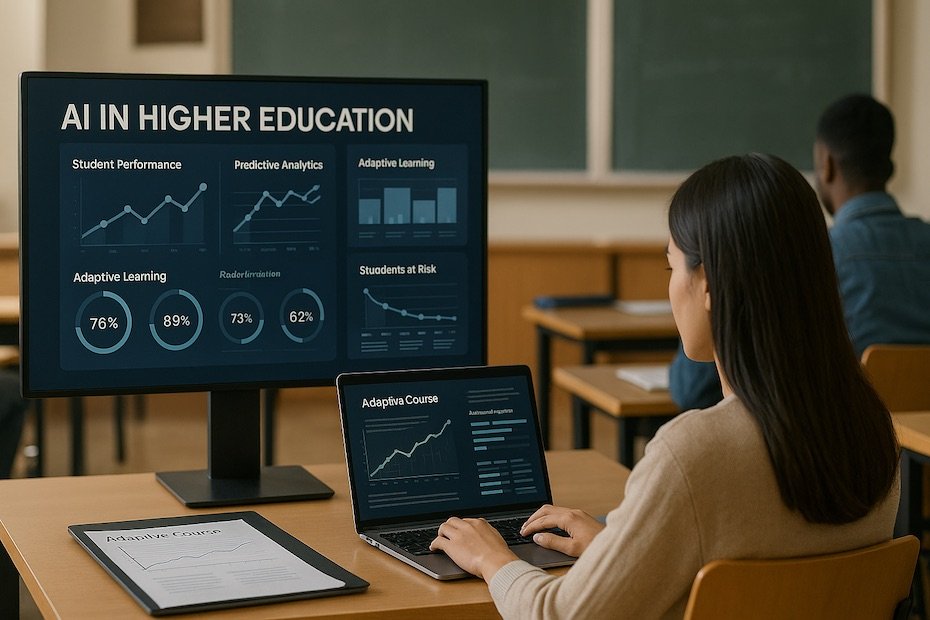
Table of Contents
- What is AI’s Role in Higher Education Today?
- How Are Students and Faculty Using AI in Daily Learning?
- What Benefits Can You Expect from AI Integration?
- What Challenges Should You Prepare For?
- How Should Universities Implement AI Strategically?
- How Will Teaching and Assessment Change with AI?
- What Emerging Trends Will Define the Future?
- AI in Higher Education
- In Conclusion
AI is reshaping higher education by personalizing learning, automating administration, and providing predictive insights that improve student success and institutional efficiency.
You can use AI to modernize teaching, enhance assessment methods, and streamline operations across departments. This article highlights the practical ways AI is applied in higher education today, the opportunities it creates, and the challenges you’ll need to manage as an academic leader.
What is AI’s Role in Higher Education Today?
AI in higher education enables adaptive learning, predictive analytics, automated grading, and administrative automation. You see it embedded in tutoring systems, chatbots, and data-driven insights.
Institutions use AI to recommend personalized learning resources, monitor student progress, and predict risks of dropout. This allows faculty and advisors to intervene earlier, making academic support more targeted.
Administrative offices also benefit. From streamlining admissions to automating scheduling, AI reduces human workload so your staff can focus on strategy and student engagement.
How Are Students and Faculty Using AI in Daily Learning?
Students are the earliest adopters of AI in classrooms. They use generative AI tools for writing drafts, summarizing readings, and studying more efficiently.
Faculty adoption is mixed. Some instructors integrate AI for course development, grading, or virtual office hours. Others remain skeptical, citing concerns about plagiarism or over-reliance.
Institutions that provide AI training workshops see smoother integration. When faculty learn how to use AI ethically and effectively, the classroom dynamic improves, balancing innovation with academic standards.
What Benefits Can You Expect from AI Integration?
AI enhances personalization by tailoring materials to each student’s progress. This ensures faster learners aren’t held back and slower learners receive targeted support.
You gain efficiency in grading and feedback. AI handles objective assessments like quizzes while offering suggestions on subjective tasks, leaving you more time for mentorship.
Predictive analytics allow your institution to identify patterns early. By spotting risk factors such as absenteeism or declining performance, you can improve retention and graduation rates.
Benefits you’ll notice most:
- Personalized learning pathways
- Streamlined grading and assessments
- Early risk detection for student dropouts
- Better institutional resource allocation
- Improved student engagement through automation
What Challenges Should You Prepare For?
The most immediate challenge is academic integrity. Students may overuse AI for assignments, making it harder to ensure genuine learning.
Another concern is bias. AI models trained on limited data may reinforce inequalities. You need strong oversight and audits to prevent harmful outcomes.
Faculty resistance is also common. Some educators fear that AI reduces their role. Addressing these concerns with transparency, training, and governance can encourage collaboration instead of conflict.
How Should Universities Implement AI Strategically?
Start small with pilot programs. Implement AI chatbots for student services or adaptive learning in introductory courses. Evaluate results before scaling across departments.
Establish governance early. A clear policy on AI use—covering ethics, privacy, and fairness—protects both your institution and its learners.
Partner with trusted vendors and researchers. Collaboration ensures tools are well-tested and aligned with your academic mission rather than being disruptive add-ons.
How Will Teaching and Assessment Change with AI?
AI will shift your teaching from information delivery to mentorship and design. Faculty become facilitators who guide discussions and shape higher-level thinking.
Assessment will evolve beyond standard tests. AI supports real-time feedback, interactive assignments, and personalized learning checks. Traditional exams remain, but they’re supplemented with AI-enabled evaluations.
For example, some systems now grade essays by providing initial feedback that faculty then refine, blending efficiency with human judgment. This hybrid model safeguards quality while saving time.
What Emerging Trends Will Define the Future?
Generative AI is becoming a learning companion. Students use it to simulate debates, solve problems, and create multimedia projects—expanding beyond text.
AI literacy is now essential. Both students and staff must understand how AI works, where it fails, and how to use it responsibly. Many universities are embedding AI ethics courses into their programs.
You’ll also see fully integrated data ecosystems. Learning management systems, student records, and predictive analytics will connect, allowing institutions to make more accurate decisions about teaching, funding, and support.
AI in Higher Education
- Personalized learning pathways
- Automated grading and feedback
- Early risk detection for students
- Smarter administrative operations
- New teaching and assessment models
In Conclusion
AI is not replacing higher education—it’s redefining how it operates. By using AI to personalize learning, streamline administration, and strengthen outcomes, you can lead your institution toward a future that prioritizes both efficiency and student success.
If you want deeper guidance on applying AI in education, connect with me through my crunchbase to explore tailored strategies for your institution.
Related Posts

Top In-Demand Skills College Students Should Learn in 2026
Discover the top in-demand skills college students should learn in 2026...

The Best Exam Preparation Techniques for Busy Students
Discover the best exam preparation techniques for busy students, including active...

Is Supply Chain a Stressful Career? The Reality No One Tells You
Is supply chain a stressful career? Learn which roles are high-pressure,...